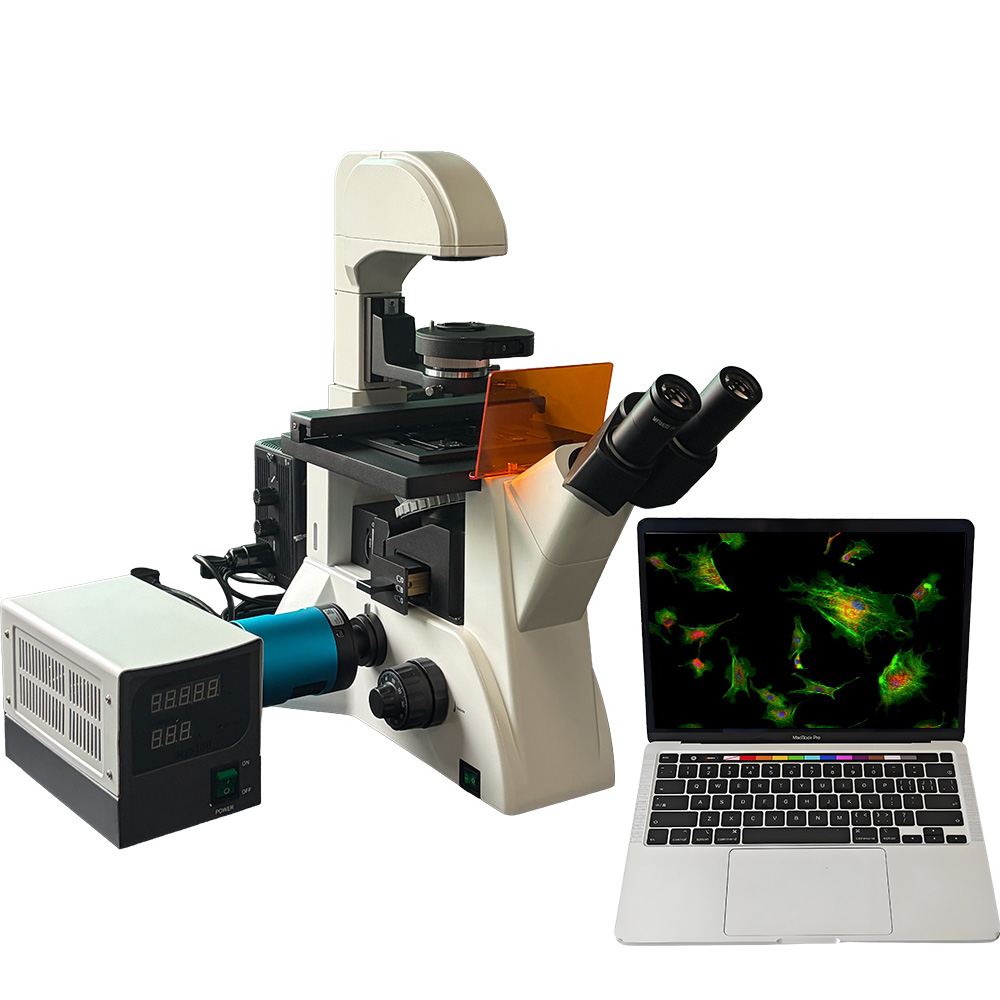
A fluorescence microscope illuminates the sample with light of one wavelength and images only the light emitted at a longer wavelength. Because the emission is generated by fluorophores — dyes, proteins or autofluorescent materials — the signal stands out against a dark background with very high contrast.
Yikmo supplies upright and inverted fluorescence microscopes with LED or mercury illumination and multi-position filter turrets, for life science and for industrial applications such as FPD inspection and forensic analysis.
The filter set is the single most important choice. An excitation filter, dichroic mirror and emission filter must match the fluorophore: FITC/GFP, TRITC/RFP, DAPI, Cy5 and so on. A mismatch loses signal and adds background.
The objective must also transmit at both wavelengths. Dedicated fluorescence objectives use low-autofluorescence glass and high numerical aperture; a standard brightfield objective will work but with lower signal.
Illumination stability matters for quantitative work. LED sources are stable, long-lived and dimmable; mercury arc lamps are brighter at some lines but degrade and require careful handling.
| Filter sets | Specify the fluorophores you use. Most labs need blue (FITC/GFP), green (TRITC) and UV (DAPI) at minimum. |
|---|---|
| Light source | LED for stability and lifetime; mercury for maximum intensity at specific lines. |
| Camera | A sensitive monochrome camera is preferred for fluorescence; colour is used when multiple channels must be distinguished visually. |
| Darkroom | The microscope should be used in dim ambient light; a light-tight stage or a dark room improves contrast. |
Phase contrast shows structure from refractive-index differences and needs no label. Fluorescence shows only the labelled or autofluorescent component, with much higher contrast and specificity.
Only if it has a fluorescence illuminator and filter turret. A transmitted-light stand cannot produce epi-fluorescence without the reflected light path and filters.
Common causes: wrong filter set for the fluorophore, low numerical aperture objective, photobleaching, or insufficient exposure. Check the filter cube first.
Send us the material and what you need to measure. We reply within one business day with a specification and quotation.