A stereo microscope produces two separate optical paths, one for each eye, so the operator sees a true three-dimensional image with depth perception. Working distances are long — typically 100 mm or more — which leaves room for tools, soldering irons and hands under the objective.
Yikmo builds binocular and trinocular stereo zoom microscopes from 0.67×–4.5× to 0.65×–5.5×, with LED ring, dual or spot illumination. Trinocular bodies accept a camera for documentation or measurement.
Unlike a biological or metallurgical microscope, a stereo microscope is designed around manipulation rather than measurement. The image is erect and correctly oriented, the field of view is wide, and the working distance is long enough to work under.
The trade-off is resolution: stereo microscopes typically top out around 200×–300× total magnification with auxiliary objectives, and numerical aperture is lower than a compound microscope. For inspection, assembly and dissection this is exactly the right balance.
| Zoom range | 0.67×–4.5× (ratio 1:6.7) covers most work. 0.65×–5.5× (1:8.5) gives a wider range when you need both overview and detail. |
|---|---|
| Working distance | 100–110 mm is standard and suits soldering. Choose a 0.5× auxiliary objective if you need 150–200 mm for tools or a hot-air nozzle. |
| Head | Binocular is enough for visual inspection. Choose trinocular if you need to photograph or measure — the camera sees the same image without switching. |
| Illumination | Ring light for even, shadow-free light. Dual gooseneck for directional light that reveals surface texture. Backlight for silhouette measurement. |
| Base | Plain base for general work; a rotating darkfield base for gemology; a large stand with 50 mm or more of vertical travel for taller parts. |


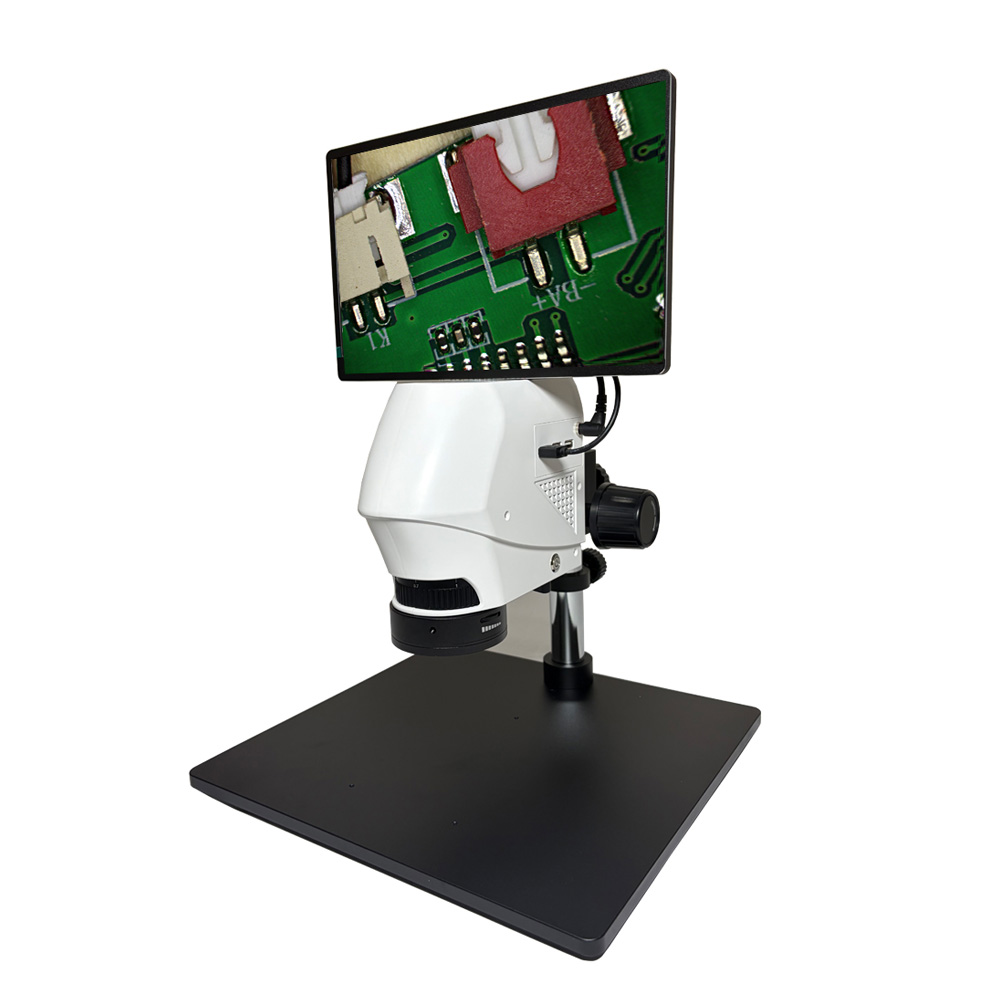
A stereo microscope has two optical paths and produces a 3D erect image with a long working distance, so you can work under it. A biological microscope has a single path, higher magnification and higher resolution, but almost no working distance and a flat image.
Yes, with a trinocular head and a C-mount adapter. A 0.5× adapter is common on stereo microscopes because it matches the small sensor and keeps the field of view wide.
Total magnification of 10×–40× covers most solder joint and component inspection. 80×–160× is useful for fine-pitch and BGA work when combined with a camera.
Send us the material and what you need to measure. We reply within one business day with a specification and quotation.
